
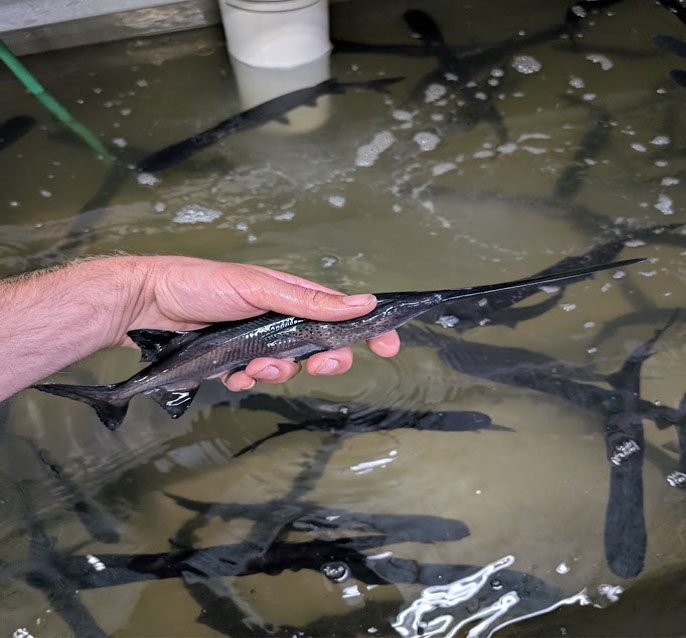
Paddlefish (Iowa DNR photo)
We hear about all sorts of surveys the Iowa Department of Natural Resources conducts every year to keep track of populations of various native creatures — from pheasants and deer to frogs and fish.
At six lakes in five northwest Iowa counties, what’s known as fall fyke netting is now underway. DNR fisheries biologist Andrew Carlson, in the Spirit Lake office, says fyke netting is one of the ways the agency monitors fish populations.
“A fyke net is essentially a big trap that we stake to the shoreline,” Carlson says. “There’s about a 30-foot lead that moves out to a frame with some hoops in it. It’s a very effective way to capture panfish, but it also captures other species that are moving shallow this time of year.”
Carlson says fyke netting is part of a comprehensive survey process, and the nets are able to capture very small fish.
“It’s a pretty small mesh actually,” he says. “So we’ve gotten them down to about 1.5 inches and a lot of the age zero crappies and bluegills are right around that 1.5 inch mark. There’s some that are smaller that go right through the net but many of them are that size or a little bigger and they do get caught. We get a good idea of spawning success and early recruitment.”
Carlson says in addition to fish population numbers, they gather other information.
“We also take length and weight information for each individual fish, five inches or greater,” he says. “The small fish are not heavy enough to have an accurate reading on the scale. But we get numbers, we get catch per unit effort, we get weight, we get length, and we can use that information to derive a variety of length-based and weight-based population metrics.”
The lakes being used for this year’s survey are Big Spirit Lake in Dickinson County, Lost Island Lake in Palo Alto County, High Lake in Emmet County, Scharnberg Lake in Clay County, and Dogwood Creek and Mill Creek Lakes in O’Brien County.
(By Ed Funston, KILR, Estherville)