
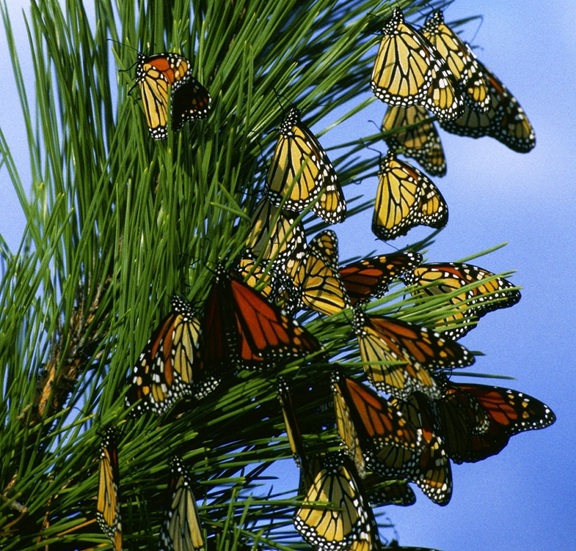
Iowans are asked to be on the lookout for groups of monarch butterflies that might be congregating in our trees and yards as the vital, orange-and-black insects begin to make the long journey south to Mexico for the winter.
Mykayla Hagaman, program specialist at the Ames-based Iowa Monarch Conservation Consortium, says now is the time when Iowans will start seeing monarch roosts and it would be helpful if people would document them.
“Monarchs generally fly during the day and they rest or roost at night in trees or sheltered areas,” Hagaman says. “Monarch roosts can consist of anywhere from 10 to hundreds of individual monarchs that are flying south during the fall migration.”
Monarchs by the millions are flitting across Iowa and the Midwest now and will continue their flight from late August through early October. Hagaman says there’s still a lot we don’t know about these fragile creatures and Iowans can help by reporting it when they spot roosts of the important pollinators.
“Monarch flight paths are often highly impacted by wind currents and things like that, so sometimes sites will be used year after year and sometimes monarchs will visit a site once and then won’t visit them again for years,” Hagaman says. “We’re really trying to learn more about monarch habitat selection for these roosts so that we can better support the fall migration.”
If you spot a monarch roost, Hagaman asks that you note the location, the date, what sorts of trees or plants the butterflies are on, and the surrounding landscape. Also, how many are there?
“It would be great if they could get any pictures of the roost — it’s always helpful, and then there’s two main ways that they could let us know about that roost,” Hagaman says. “One is by reporting it through Journey North, which is a monarch conservation group where you can report monarch sightings, or you can e-mail us at [email protected].”
Hagaman says all reported data will remain anonymous. Monarch populations have declined significantly in recent decades due to factors like habitat loss and extreme weather. She says Iowa plays a crucial role in their migration corridor, and by documenting roosting sites, landowners are directly contributing to the science that guides conservation strategies at home and across the continent.