
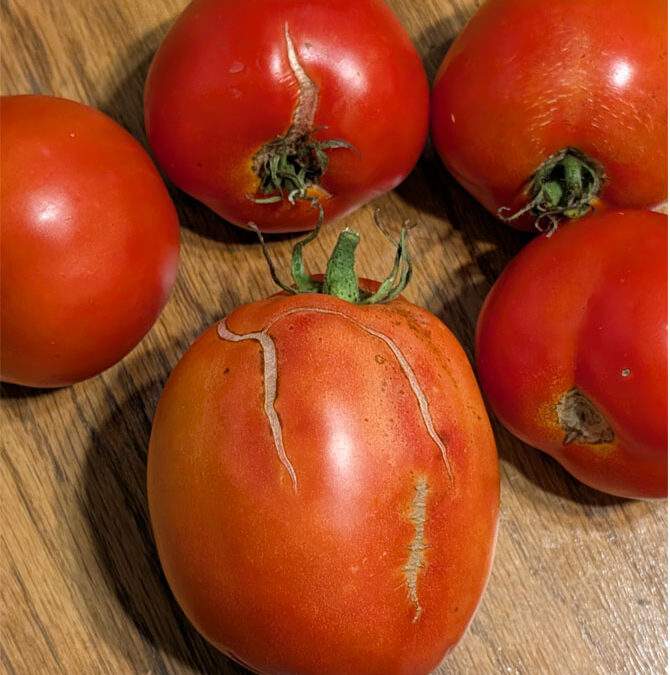
Many people are reporting a big bounty from their gardens this year thanks to a plenty of rain and heat.
Iowa State University Extension Horticulture specialists Aaron Steil says those conditions have also led to problems for plants like tomatoes. “We’ve had a lot of rain. It’s kind of come in big events across much of the state. And that can help lead to blossom end rot. And it can also lead to fruit cracking,” he says.
Steil says certain tomato varieties are more prone to getting those cracks. “Whether they’re kind of radio or they’re concentric rings around the stem. Both of them are caused by the same thing, and that’s a big influx of water and basically it causes the fruit to swell up so quickly that it cracks the skin,” he says. He says some varieties like Romas have a little bit thicker skin and are more resistant to cracking, and big slicing tomatoes are also more resistant to cracking as well. He says the good news you can still eat the tomatoes if they crack.
Blossom end rot is caused by something else. “At its core, it’s caused by a lack of calcium. But the reason why the plant is lacking calcium is because there’s not adequate water to help move that calcium from the soil, which there’s usually plenty of in the soil, up into the plant and all the way to that developing fruit,”Steil says. Steil says you can take some steps to keep these diseases out of your tomatoes by stopping big swings in too much or too little water.
“Anything we can do to help reduce that, putting down mulch, watering when it’s dry or trying to keep up with watering so that there’s not a big change in the amount of water that’s available to the plant when we do get big rain events can make a difference with this,” he says.
You may also see blossom end rot on other vegetables like peppers, squash, cucumbers and eggplant, with the rotten end furthest from the stem. There are other diseases also hitting veggies. “Things like powdery mildew on cucumbers and squash, septoria leaf spot and early blight on tomatoes. It’s been really common this year too,” he says. “Bacterial speck and spot on things like tomatoes and peppers and eggplant. They’re all there and some of this stuff looks familiar. It’s just maybe a little bit worse this year because of the weather.”
Tomatoes aren’t the only garden grower susceptible to too much water and splitting. “I’ve heard about melon splitting as well, especially cantaloupe and muskmelon. And when we do have wet conditions, we always run into some instances where we see kind of the bottom of the fruit rotting. using like a shingle or a small piece of wood to put place under them can help with that to a certain extent,” Steil says. He says you should check the melons frequently as they start getting ripe enough to harvest so that it’s not sitting out there too long and start to rot.
Steil says the hot summer and abundant moisture has really promoted a lot of growth and a lot of fruit production for a good chunk of the state, with the exception of northwest Iowa, which continues to experience dry conditions.