
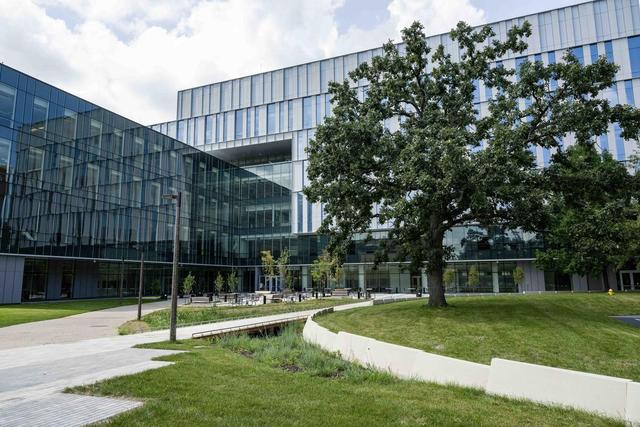
The ribbon will be cut this afternoon on a quarter-billion dollar building at the University of Iowa housing three separate but related top-ranked programs.
Ground was broken in October of 2023 on the new Health Sciences Academic Building, which is located just south of Slater Residence Hall.
Eric Hunter, chair of the UI’s Department of Communication Sciences and Disorders, says it’s a stunning six-story addition to the Iowa City campus.
“It’s shaped like an L. The hospital is on one side and on the other side, we have some dorms and there’s a nice basketball court. There’s a beautiful courtyard,” Hunter says. “It’s just a wonderful space. The architectural firms and the construction company did just an amazing job. It’s a beautiful building.”
Professor Hunter says the new structure puts the three programs under one roof — Communications Sciences and Disorders, Health and Human Physiology, and Physical Therapy and Rehabilitation Sciences. He says Communications Sciences and Disorders encompasses things like children with autism, people who use hearing aids, and post-stroke patients who are learning to speak and swallow again.
“We have a full wing that is our speech and hearing clinic with full services there,” Hunter says. “Then we have 18 laboratories all devoted to hearing sciences, audiology, speech language pathology, children to adults.”
Many hundreds of students, researchers and educators are already using the building, which is also welcoming scores of visitors and patients.
“The classrooms are wonderful. We have two large lecture halls, which actually fit us well, but it also fits Health and Human Physiology well,” Hunter says. “They’re the largest undergraduate program on campus, like 2,500 students or something like that, so they have a lot of students going through those lecture halls.”
A wide range of students will be attending classes in the new facility, including pre-med, kinesiology, anatomy, sports management and many other disciplines. Hunter says he expects plenty of synergy between the three departments, working toward ways to perhaps join graduate programs and cross over their inter-professional practices.
“When you’re doing training, and you’re doing research, it’s very easy to lock yourselves down into a silo,” Hunter says. “Proximity does matter. So to have three programs that have so much supporting expertise as well as complementary expertise in the same space naturally turns into work.”
The dedication and ribbon cutting ceremony is scheduled for 3 PM.