
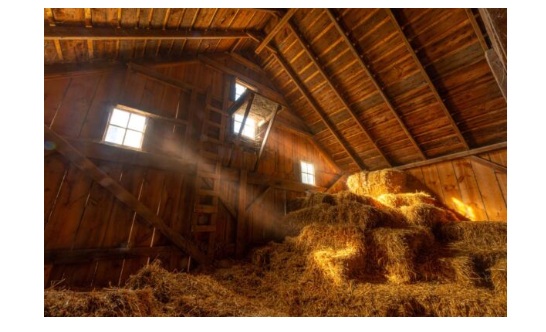
Iowa’s rich agricultural heritage runs deep and perhaps no other state has preserved as many historic barns, whether they’re red or white, round or rectangular.
A celebration of Iowa’s barns will be held this month for the 26th year. The All-State Barn Tour opens the barn doors wide to visitors in nearly every Iowa county.
Wayne Frost serves on the board of directors for the Iowa Barn Foundation, and he says sizeable crowds turn out every autumn for the two-day tour.
“Three years ago, I hosted a June tour at my barn and a few others and I had 800 people just at my barn alone,” Frost says, “so when you figure that we have 108 stops this year across the state, it’ll be a pretty significant number.”
Frost’s red barn in southern Black Hawk County was built in the 1870s for horses and milk cows, and it’s been in his family for eight decades. He says an Amish construction crew worked over seven weeks in 2018 to fully restore the majestic structure.
“It’s a large barn, about 88 foot long, 40 wide, 40 high. It’s got three-foot-thick limestone walls, big heavy beams with a tenon and mortise joint and pins in it,” Frost says. “Each barn was built for its location, so there’s not much of a cookie cutter approach to how barns were built across Iowa.”
The organization’s website features photos of each of the 108 barns on this year’s tour, with details about the history of each structure. Think if you’ve seen one barn you’ve seen ’em all? Think again. Frost says they’re all unique and packed with history and there’s at least one near you that’s worth exploring.
“You can go out to the website, look at these barns. It has an address where they’re located and say, hey, this one would be really of interest to me based upon how I grew up, what I’m aware of barns, and do you want a horse barn, a cattle barn, what type of barn?”
Round barns became popular in the 1920s as they were billed as being more efficient, often with a silo in the center, but Frost says they were more difficult to construct. Iowa had more than a hundred round barns a century ago and there are 16 circular survivors on this year’s tour.
You’ll see some white barns, but the majority of them are painted red. Why is that?
“A lot of the earlier barns that were built across the United States were not painted at all,” Frost says, “but to preserve the wood, when they started using paint, they added some iron pigments to the paint that was red, and so hence, you had a lot of red barns.”
This year’s tour will be held the weekend of September 19th and 20th. It’s self-guided and free.