
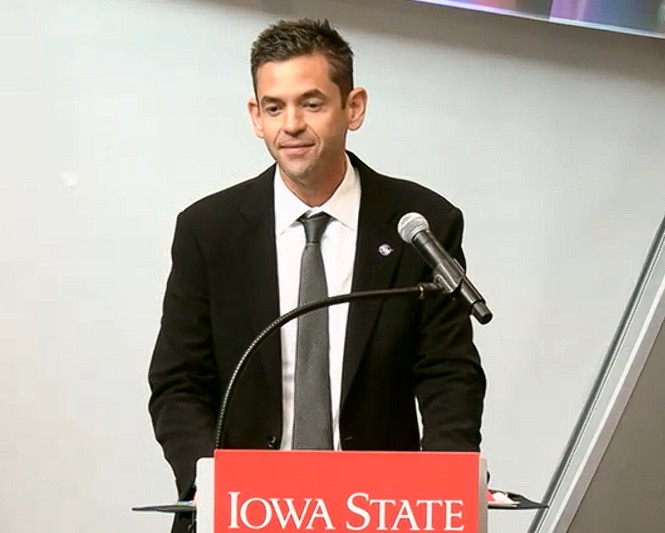
NASA Administrator Jared Isaacman visited Iowa State University and Ames National Laboratory today. Isaacman wrapped up his visit with a speech to a full auditorium of students and told them they are going to be part of the most exciting era of exploration since the Apollo missions.
“Going to the moon is no longer going to be just a story you’ve heard about from your parents or read about in the history books. Your generation will more than witness it. You’re going to be part of it,” he says. He says America is very much back in the business of sending astronauts to the moon and today’s students are the Artemis generation. Referring to the Artemis II mission that carried the crew farther into space than any humans in history around the moon for the first time in more than half a century.
“And Artemis II was just the opening act. We are accelerating Artemis III and launching one of the most complex human spaceflight missions ever attempted just next summer,” he says. “Four astronauts, three heavy lift launch vehicles, two dockings, one splashdown will pave the way for Artemis IV when America finally makes its grand return to the lunar surface in 2028.”
Isaacman says the return to the moon sets up the next step in space exploration. “We are not going back for just the flags and footprints. We are going back to stay. We are building humanity’s first enduring outpost in another world, the moon base,” Isaacman says. “Think about what that actually requires. Power that can survive the lunar night, habitats that protect astronauts in an extremely unforgiving environment, crude and autonomous mobility across difficult terrain, communications, navigation, logistics, construction.”
Isaacman told the students they can be directly involved in the effort. “We are going to need the best and brightest to help us achieve our near impossible missions, and Iowa State is already preparing so many of you to do exactly that. Students here are building rockets through CyLaunch, developing technologies for lunar resource utilization through the Cardinal Space Mining, and have already designed and flown cube satellites in space just this past year,” Isaacman says.
He told the students they can be the astronauts, mission control operators, or be the nuclear engineer building the spacecraft to take us to the next destination. “And decades from now, when the history books look back on this moment, the moment humanity became a true spacefaring civilization, the people responsible, the generation that will have made it happen, are represented right here in this room,” he says.
Isaacman brought along some moon rocks from one of the Apollo missions and a lunar vehicle that the ISU students could look at as part of his pitch for them to think about a career with NASA.