
Rob Sand, the Democratic Party’s nominee for governor, says it makes sense to classify staff in Iowa’s prison system as public safety employees, which would give them the right to raise more issues when they’re negotiating contracts.
Republican lawmakers changed Iowa’s collective bargaining law in 2017, setting base pay as the only subject for negotiations with public sector unions. “You don’t have to have any experience in the Department of Corrections or with Chapter 20 to understand that if the only thing you can negotiate is your pay, then you can’t negotiate at all,” Sand said.
However, public safety employees have been exempted from that limit since 2017. That means state troopers, for example, may still negotiate on topics like overtime pay, health insurance and safety issues. “If you work in a correctional facility, obviously you should be able to be pushing for your own safety around convicted criminals,” Sand said.
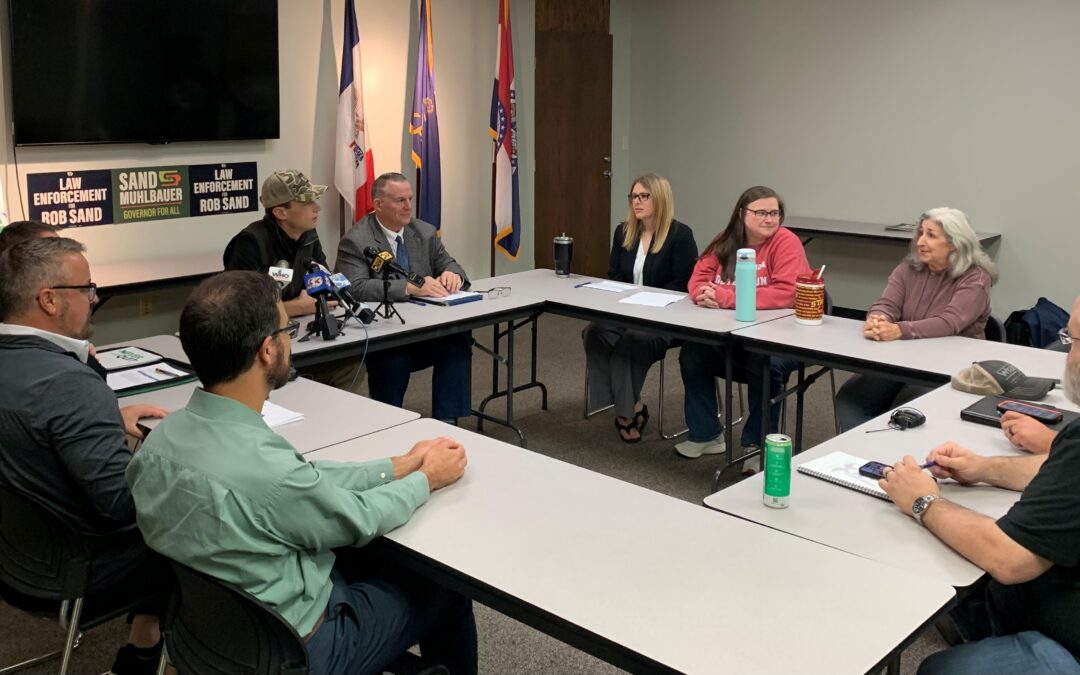
Sand made his comments Tuesday during a forum at the headquarters for AFSCME Council 61, the union that represents prison staff and other employees who work in state and local government in Iowa. Neal Lamaster, a registered nurse at the Iowa State Penitentiary in Fort Madison, said the prison is so understaffed a colleague recently worked 180 hours in a two-week period and 100 of those hours were overtime. “You’re trying to do more with less and you want to help, but you get to a point where what do you do?” Lamaster said.
Lamaster, who’s been a prison system employee for 29 years, intends to stay because he’s nearing the point of earning full retirement benefits, but Lamaster told Sand pay is not high enough to attract new employees. “Everyone around us is increasing these wages. You’ve got Siemens, the fertilizer plant,” Lamaster said. “My son works at the fertilizer plant. I had to go to school for three years to become a nurse. He has a high school diploma. He makes more money than me.” Lamaster said even some of the inmates tell him more staff is needed to reduce the threat of being assaulted by another inmate.
Todd Eaves, a correctional worker at the Iowa State Penitentiary since 1997, sat next to Lamaster at Tuesday’s roundtable discussion. “The people that trained us that started in the ’70s and the ’80s always told us: ‘We don’t get paid for what we do. We get paid for what might happen,'” Eaves said. “That’s not the case anymore.” There was an 11-hour-long riot at the Iowa State Penitentiary in 1981. Inmates took hostages and after negotiations ended the standoff, one inmate was found stabbed to death.
During yesterday’s forum with Sand, seven other prison employees raised concerns about high staff turnover and a lack of mental health treatment for juvenile offenders. A few told Sand a new Iowa law requiring mandatory 20 year prison sentences after a third felony or violent misdemeanor conviction will likely force the state to build a new prison. Republicans have 100 of the 150 seats in the state legislature and Sand often tells audiences he expects Republicans to retain majority control of the legislature in 2027. It’s unlikely Republicans would agree to repeal the three-strikes law, but Sand said if there are legislators “who think there are better ways to protect public safety, I’m all ears.”