
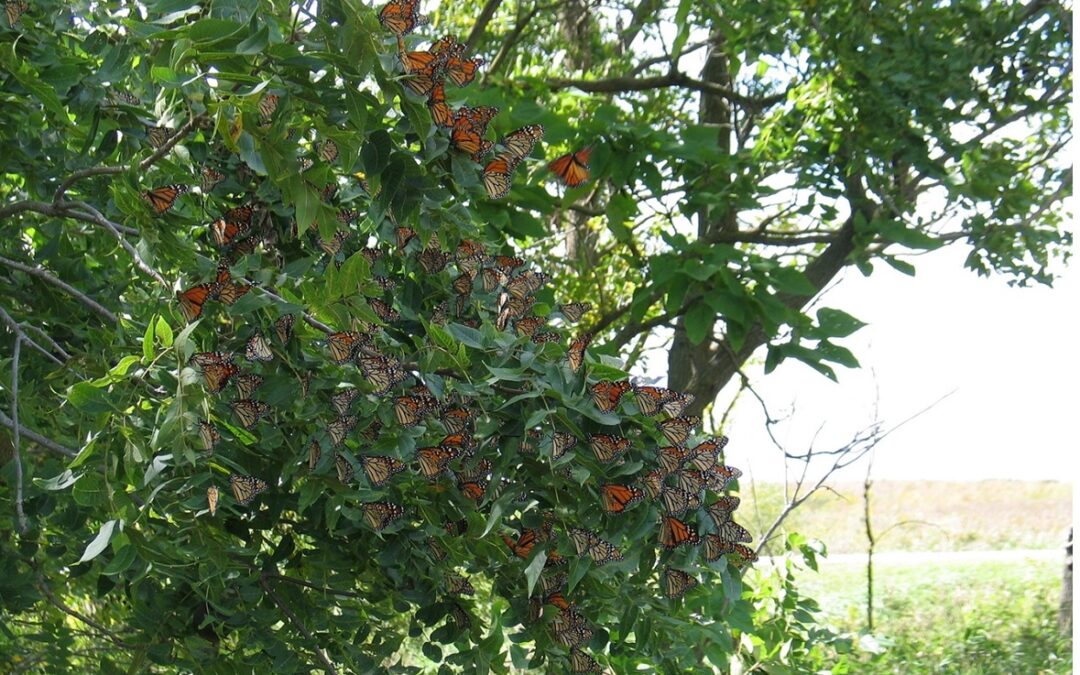
Iowa is in the middle of a monarch flightpath as millions of the tiny insects migrate toward Mexico, and Iowans can help researchers to track patterns and preferences by reporting monarch roosting sites.
Katherine Kral-O’Brien, at the Iowa Monarch Conservation Consortium, says Iowans may spot large clusters of perhaps hundreds of the orange-and-black butterflies taking a rest in a treetop.
“We often think of monarchs as being out on flowers and more in grassland areas, but a monarch roosting site is sometimes difficult to see because they’ll have their wings closed,” Kral-O’Brien says, “but especially if there’s a bunch of them there, which is what we’re looking for, they should be pretty easy to see. They’ll contrast their orange colors with the green leaves.”
Kral-O’Brien, a professor in Iowa State University’s Department of Natural Resource Ecology and Management, says there’s a simple online form folks can fill out if they spot the important pollinators congregating.
“If Iowans can report where they see monarchs roosting, we can maybe get an idea of which trees they want and if there’s other features in the landscape or around those trees that they like, like flowering plants,” Kral-O’Brien says. “So if we can get an idea of where they’re roosting now, we can potentially ask Iowans to maybe plant more of those trees and get more of that habitat out on the landscape.”
Iowans have reported seeing fewer roosts in recent years, as monarch populations have fallen significantly due to factors like habitat loss and extreme weather.
Wide sections of Iowa have seen recent overnight temperatures in the 40s and 50s, which is activating instincts in the insects to head south, pronto.
“With these colder temperatures, getting those roosting sites where they can cluster together is going to be really important because that’s how they can stay warm and have a little bit of extra insulation from the other monarchs that are around them,” Kral-O’Brien says. “A lot of times that will kick in to them that they need to start migrating, stop doing their summer activities and it’s time to think about winter.”
She says roosting will often occur in the evening and early morning, in sheltered areas, near the edge of woodlands, windbreaks or river corridors. Roost sites can also be reported with Journey North to help researchers and conservationists from around the country.