
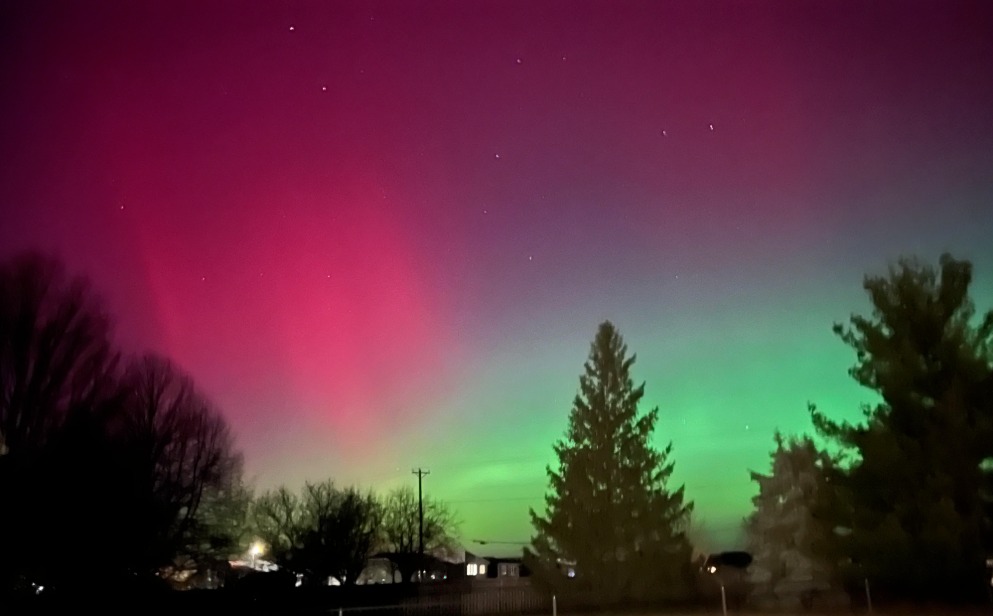
Many Iowans were able to witness a rare weather phenomenon last night as the bright greens, pinks and reds of the Northern Lights were visible for several hours, and there may be a repeat performance tonight.
Meteorologist Alex Gibbs, at the National Weather Service office in Davenport, says it was a true treat to see the nighttime sky show.
“They were directly overhead as opposed to on the horizon, some bright, brilliant reds and some streamers came off of them,” Gibbs says, “but I also saw the office here, the staff was able to get some pictures around the radar of the Northern Lights.”
Social media accounts are clogged this morning with dazzling photos of the lights, and many people are noticing how the cameras in our smart phones seem to capture even better images than we’re seeing with our eyes.
“Your camera can get more light into it than our eyes can, but last night was so good that I didn’t need my camera to see the Northern Lights at all, especially once I got outside of the light pollution,” Gibbs says. “I left the city and got into a darker area and they were dancing above my head.”
Forecasters say conditions may be favorable to see the famed aurora borealis again this evening, if weather permits.
“The Space Weather Prediction Center is denoting that the CME, which is essentially a corona mass ejection,” Gibbs says. “That eruption, basically the heart of that core, is currently hitting the U.S. right now and that’s expected to last most of today and possibly through the overnight.”

Prof. Allison Jaynes (UI photo)
While the forecast calls for partly to mostly cloudy conditions for much of Iowa this evening, Gibbs says we may still be able to see the swirls of color in the patches of open sky.
If you’ll be venturing out tonight to try your luck, University of Iowa physics and astronomy professor Allison Jaynes offers a few tips for how best to view the Northern Lights.
“Normally, I tell people to look north and have some kind of clear horizon to the north, however, last night was so surprisingly large of a storm that people sometimes had to look overhead,” Jaynes says. “But in general, yes, you want to look towards the north, which is where the aurora is going to be at an angle from your viewpoint, because we’re at slightly lower latitudes than where it normally occurs.”
Even if it doesn’t look like a very bright light show, Jaynes says it’s worth trying to shoot some long-exposure photos with your smartphone. If you’d like to try, she says, don’t just hold the phone up and shoot.
“If you have something solid to rest it on and a timer where you can start the exposure and then set your phone down and walk away and just let it take the picture, that’s the best,” Jaynes says. “Even just our regular ‘night mode’ that our cameras automatically switch into when we’re in the dark. That will usually do the trick, but definitely have something you can either lean it on, the hood of your car or a fence post, so that it’s got no jitter from your hands.”
The sun will set late this afternoon at 4:57.