
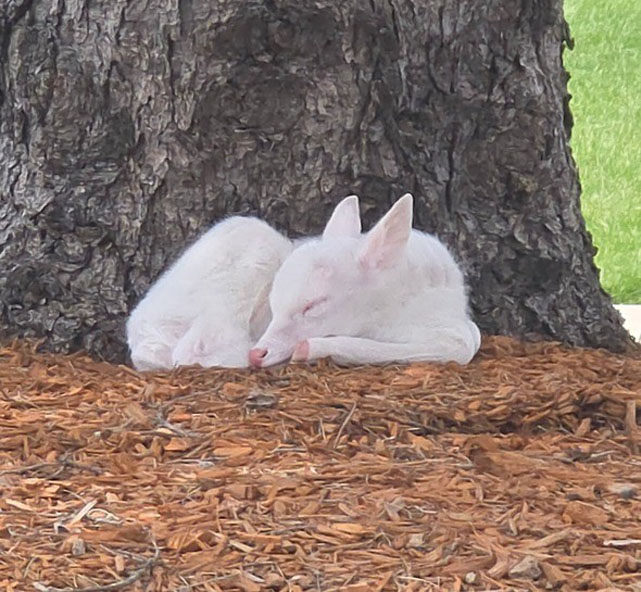
The sighting of white fawn on the Indian Hills Community College in Ottumwa has created a stir in southern Iowa.
DNR state deer biologist Jace Elliott says it’s not something you see every day. “We do get reports of white deer periodically throughout the year across the state. So it’s not the first white deer that we’ve had reported in Iowa, but it certainly is a very rare anomaly in our wild deer population,” Elliott says. He says the white coloring means the deer is either albino or leucistic.
“The result of recessive genes that cause an abnormal coat coloring. And actually pigment in the ears, nose, and hooves also appear to be white or lacking melanin. And so it’s actually somewhat likely that this deer is actually a true albino,” he says. The odds of a white deer being born aren’t as high as the odds of winning the lottery. “Researchers think that there’s about a one in 20,000 to one in 30,000 chance of having a deer with discoloration. Of course, once it carries those genetics, if it’s successful in breeding in the future, it could produce more white offspring. And these deer are protected from harvest in Iowa,” Elliott says.
Fawns are normally born with white spots on their brown coats to help camouflage them from predators. Elliott says the location of this deer should help it avoid that. “Given that this fawn was born in sort of a suburban urban interface, it’s unlikely that it’s going to experience predation in that sort of environment,” he says. “And I would say that the fawn has a quite good chance of survival given where it was born.”
Elliott says to much attention from humans is a danger for the fawn. “Naturally, a lot of folks are going to be seeking that deer out or at least, you know, creating some level of disturbance. We would just recommend that for the deer safety and for the maternal doe as well, that folks just keep a safe distance,” he says. “Of course, it’s all right to take pictures, but just be sure to move along and not create a large disturbance as that can sometimes have negative consequences for the wildlife.”
Elliott says that goes for any deer or other animals. He says the peak fawning season for deer is a couple of weeks from now.