
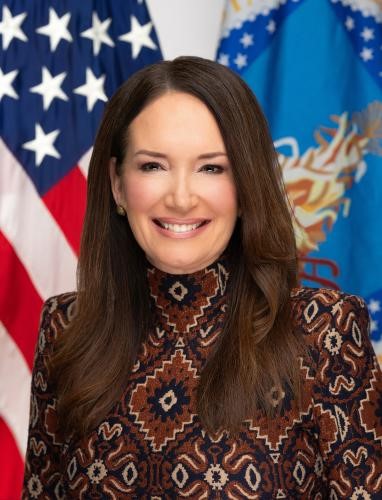
U.S. Agriculture Secretary Brooke Rollins visited the Farm Progress Show in Boone yesterday, touting announcements for the cattle industry that came after President Trump waived tariff charges on imported beef for 90 days to reduce ground beef prices for consumers. The move caused cattle prices to drop.
The USDA will offer an insurance product for cattle producers who retain heifers and cows to grow their herds and the agency will provide more loans for regional beef processors. “The ‘Big Four’ concentration of our packing has not been conducive to rebuilding the herd, to supporting our independent ranchers,” Rollins said, “to incentivizing young farmers and ranchers to get into the business.”
The number of cattle in the U.S. recently hit a 75-year low as farmers sold cattle they could not feed after droughts reduced the volume of grass available in pastures. Rollins promises the USDA will be more flexible in granting access to Conservation Reserve Program acres for grazing or providing hay to cattle. She also hinted the president will make a meat labeling announcement later this week. “We are putting protein, we are putting beef right back at the center of policymaking in Washington, D.C.,” Rollins said.
On Monday, the EPA announced 29 refineries are getting waivers this year so they do not have to add ethanol to gasoline. Rollins told the crowd in Boone the Trump Administration will ensure refiners blend the gallons reduced from this year’s tally into gasoline by 2027. “We’ve also issued summer waivers for E15 and continue to support E15 year around for our congressional leaders to finally get that done,” Rollins said, to applause. “It couldn’t be more important.”
Rollins, who spoke for nearly 40 minutes, also announced the USDA will improve smart-phone access to surveys and launch an experiment to evaluate how satellite images may be used to calculate yield estimates. Rollins said the initiative will reduce the duplicative surveys and forms farmers have been required to fill out. “We are adjusting and working and moving at warp speed to modernize our data systems at USDA,” Rollins said. “Since President Lincoln’s creation of the Department of Agriculture in 1862, the collection and dissemination of agricultural statistics has been a key part of our mission.”
Rollins said the plan will improve the accuracy and timeliness of USDA reports that are widely used by farmers and others in the ag industry to make decisions.